


You’re sitting in your car on Ventura Boulevard and the other driver just ran a red light. Your hands are shaking. Your neck hurts. You don’t know if you should move the car, call the police, or just try to breathe.
What you do in the next few minutes has a direct effect on whether you can recover compensation later. Not just a little effect. A significant one.
This post walks through every step our car accident attorneys recommend — in the order they actually matter — so you know what to do before you ever need to use it.
Need Assistance With Your Case? Get a Free Case Review.
If you find yourself on the wrong side of the law, let us put our knowledge and experience to work for you.
📞 Call Big Joe NowStep 1: Check Yourself and Your Passengers for Injuries
Don’t get out of the car immediately. Take a breath first. Check yourself for pain, dizziness, or any sign that something is wrong, then check anyone else in the vehicle.
Adrenaline masks pain. A traumatic brain injury can feel like nothing more than a dull headache in the first hour. Spinal injuries can feel like soreness. If anyone is hurt — or if you’re not sure — call 911 before you move.
If the cars are drivable and no one appears seriously injured, move vehicles out of active traffic when it’s safe. Ventura Boulevard through Encino, Sepulveda at rush hour, the Balboa on-ramp to the 101 — these corridors don’t stop. A car sitting in a live lane is a second accident waiting to happen.
If you’re able to get yourself to a hospital, these are the closest options to Encino:
- Encino Hospital Medical Center: 16237 Ventura Blvd, Encino — a full-service hospital with emergency care a few minutes from most parts of the neighborhood.
- Providence Cedars-Sinai Tarzana Medical Center: 18321 Clark St, Tarzana — a few miles west on Ventura with a full emergency department.
- Valley Presbyterian Hospital: 15107 Vanowen St, Van Nuys — roughly 10 minutes north, another option if the others are backed up.
- Kaiser Permanente Woodland Hills Medical Center: 5601 De Soto Ave, Woodland Hills — about 15 minutes west on the 101 for Kaiser members.
If there is any doubt about the severity of your injuries, call 911 and let paramedics come to you. Don’t drive yourself to the ER if you’re dizzy, in serious pain, or unsure whether you’re okay to be behind the wheel.
Step 2: Call the Police and Get the Crash on Record
Call 911. Even if it seems minor.
California law requires you to report any accident involving injury or death. But beyond the legal requirement, a police report creates an official record — what happened, who was involved, what the responding officer observed at the scene. Insurance companies treat documented crashes differently than undocumented ones.
When the officer arrives, stick to facts. Don’t speculate about fault. Don’t say you’re fine if you’re genuinely not sure. Get the report number before they leave. Depending on where the crash happened, the responding agency will be either the LAPD or the California Highway Patrol, and both allow you to request the full report once it’s filed.
Step 3: Photograph Everything Before Anyone Moves On
Pull out your phone before the other driver gets back in their car.
Photograph both vehicles from multiple angles — close-ups of every point of impact, wide shots showing where each car ended up relative to the intersection or lane markings. Photograph skid marks. Traffic signals. Any road conditions that contributed. If you’re on Balboa near the 101 interchange and the signal timing was a factor, photograph that signal.
Visible injuries matter too. Bruising, cuts, swelling — photograph them immediately. Weeks later, when an adjuster is questioning how serious the crash actually was, those images do work that words can’t.
Witnesses disappear fast. If someone stopped or saw what happened from a nearby parking lot or sidewalk, get their name and number before they leave.
Step 4: Exchange Information — and Only Information
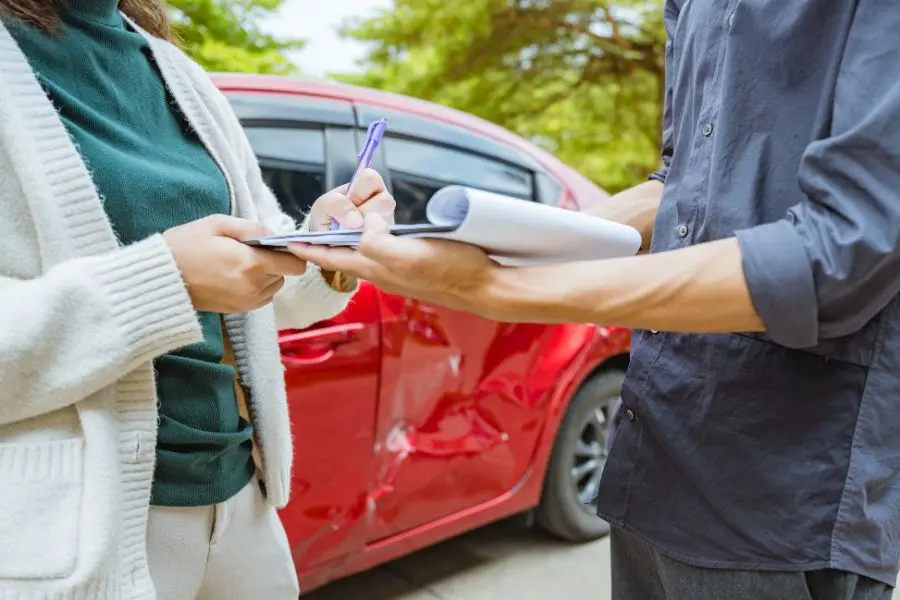
You need four things from the other driver: name and contact information, driver’s license number, insurance company and policy number, vehicle registration.
Give them yours in return. That’s it.
Don’t discuss what happened. Don’t walk through the sequence of events. Don’t say anything about fault, even offhandedly. Casual comments at the scene have a way of showing up later in claim notes. Keep it brief, keep it factual, and let the process handle the rest.
Step 5: See a Doctor the Same Day — Not Tomorrow
Go that day. Even if you feel okay. Especially if you feel okay.
A gap between the crash and your first medical visit is one of the first things an insurance adjuster uses to minimize a claim. Three days with no treatment becomes: how serious could it really have been?
Encino has urgent care options along Ventura Boulevard near Lindley and White Oak. Encino Hospital Medical Center is on Balboa. Providence Cedars-Sinai Tarzana is right on Ventura a few miles east if the situation warrants an emergency room. Any of them will do — the key is going.
Tell every provider exactly how the injury happened. Specific. Those notes tie your treatment directly to the crash and become part of your permanent medical record. Vague notes create problems later.
Step 6: Report to Your Own Insurer — But Know What You’re Not Required to Say
Notify your insurance company. California law and most policy agreements require it, and failing to report can affect your coverage.
Reporting to your own insurer is not the same as giving a recorded statement to the other driver’s insurance company. Two completely different things. You are not required to give a recorded statement to an adverse insurer. You don’t have to take their call on their timeline. You don’t have to agree to anything before talking to an attorney.
When you call your own insurer, report the facts. Don’t estimate fault. Don’t describe your injuries in detail if you don’t yet know the full picture. If you’re unsure what to say, talk to our car accident attorneys first.
Step 7: Build a Paper Trail Starting the Day of the Crash
Start a folder — physical, digital, doesn’t matter — and put everything in it.
- Medical records and bills: Every visit, every test, every prescription connected to the crash.
- Out-of-pocket expenses: Mileage to appointments, medications, anything the injury cost you directly.
- Lost income documentation: Missed days, reduced hours, written confirmation from your employer.
- A daily pain journal: Short notes about how you’re feeling, what you can’t do, how this is affecting your actual life. Specific entries — “couldn’t pick up my kid on Thursday, shoulder pain woke me up at 3am” — carry more weight than general claims of suffering.
- All correspondence: Every email, letter, or phone call with any insurance company or medical provider, with dates.
Our car accident attorneys use exactly this kind of documentation when calculating damages and negotiating. The more complete it is, the stronger the position.
Step 8: Talk to a Car Accident Attorney Before You Sign Anything
The other driver’s insurer will call fast. Sometimes within 48 hours. The offer will sound reasonable. It almost certainly won’t cover everything — not once the full picture of your injuries becomes clear.
Sign a release and that’s it. Permanent. You cannot go back.
California gives you two years from the date of the crash to file a personal injury lawsuit. That window exists for a reason. It gives you time to understand what you’re actually dealing with before making a decision you can’t undo.
Big Joe Law offers free consultations for car accident victims in Encino and across the San Fernando Valley. Our car accident attorneys will go through the facts, give you a straight assessment of what your case is worth, and make sure you understand every option before anything gets signed. Call us.
Car Accident Injuries That Require an Encino Car Accident Lawyer
Not every fender bender needs an attorney. But certain injuries change the stakes completely — and when they’re involved, going it alone against an insurance company is a serious mistake.
These are the injuries our car accident attorneys see most often in Encino cases, and why each one warrants legal representation:
- Traumatic brain injuries: Symptoms can be delayed and are frequently downplayed by insurers. Long-term cognitive effects require expert medical testimony to value properly.
- Spinal cord injuries and herniated discs: These often require surgery, long-term physical therapy, or permanent lifestyle modifications — costs that a quick settlement offer will never fully account for.
- Broken bones and fractures: Multiple fractures, surgical repairs, and extended recovery times push damages well beyond what an adjuster’s initial offer reflects.
- Soft tissue injuries: Whiplash and ligament damage are routinely disputed by insurance companies. Our car accident lawyers know how to document and prove these injuries.
- Internal injuries: Organ damage and internal bleeding aren’t always visible at the scene. By the time the full picture emerges, an insurance company may already be pushing you toward a fast resolution.
- Scarring and disfigurement: Permanent scarring affects quality of life in ways that are difficult to quantify without legal experience and the right medical support.
- Wrongful death: When a crash kills someone, the family faces a completely different legal process — one that requires an attorney from day one.
If your injuries fall into any of these categories, contact our car accident attorneys at Big Joe Law before you speak with the other driver’s insurance company.
How an Encino Car Accident Lawyer Can Help
Our car accident attorneys handle every part of your claim so you’re not going up against an insurance company alone.
- Investigating your Encino car accident: We gather police reports, witness statements, and physical evidence to build a clear picture of what happened and who was at fault.
- Calculating the full value of your claim: Our car accident lawyers account for every loss — medical bills, lost wages, future treatment costs, and pain and suffering — before any number gets put on the table.
- Handling all communication with insurance companies: We deal with adjusters directly so nothing you say gets used to reduce what you’re owed.
- Identifying every liable party: Some Encino crashes involve more than one responsible party — a negligent driver, a vehicle manufacturer, or a government agency responsible for a dangerous road condition.
- Negotiating a fair settlement: Our car accident attorneys push back against lowball offers and don’t settle until the number reflects your actual damages.
- Taking your case to trial if necessary: If the insurance company won’t offer what your case is worth, we take it to court.
- Meeting California’s filing deadlines: The statute of limitations for car accident claims in California is two years. We make sure nothing gets missed.
If you were hurt in a car accident in Encino, the sooner our car accident attorneys get involved, the stronger your claim. Call Big Joe Law for a free consultation.
Hurt in an Encino Car Accident? Call Big Joe Law.
You were in a crash. You’re hurt. And the insurance company is already working on their side of this. Our car accident attorneys at Big Joe Law offer free consultations — tell us what happened and we’ll tell you exactly where you stand.
Need Assistance With Your Case? Get a Free Case Review.
If you find yourself on the wrong side of the law, let us put our knowledge and experience to work for you.
📞 Call Big Joe Now