


April is Distracted Driving Awareness Month. For drivers on Los Angeles roads, it is also an appropriate time to confront what distraction is actually doing to people in this state.
Not in general terms. In specific ones.
One Distracted Driving Statistic Every California Driver Should Know
At 65 miles per hour, reading a text takes 4.6 seconds — enough time to cover the full length of a football field without looking at the road. That figure comes from the California Highway Patrol, and it is the kind of number that sounds extreme until you realize most people have done it dozens of times.
4.6 seconds. A football field. No eyes on the road.
The problem with distracted driving is not that it causes a crash every time. It is that it rarely does — until the one time it doesn’t. Every glance that ends without incident trains a driver to believe the next one will too. The habit builds quietly. And then conditions change, traffic stops, someone steps into the street, and the margin that was traded for a text is precisely the margin that was needed.
Need Assistance With Your Case? Get a Free Case Review.
If you find yourself on the wrong side of the law, let us put our knowledge and experience to work for you.
📞 Call Big Joe NowHow Many People Distracted Driving Kills and Injures in California
Nationally, distracted driving claimed 3,275 lives in 2023, according to the National Highway Traffic Safety Administration. That averages out to roughly nine deaths every day.
California’s share of that toll is substantial. According to the California Office of Traffic Safety, 148 people were killed in crashes involving a distracted driver in 2022. In the same reporting period, the California Highway Patrol documented nearly 10,000 people injured in distracted driving crashes statewide.
Los Angeles County sits at the center of this problem. According to data from the California Department of Transportation, 23 percent of the state’s fatal and serious injury crashes occur in Los Angeles County — a county that makes up 26 percent of the state’s population and 22 percent of its daily vehicle miles traveled.
These roads are among the most congested in the country. Stop-and-go traffic encourages drivers to pick up their phones. Surface streets through Encino, Sherman Oaks, and the broader San Fernando Valley move at speeds that feel forgiving right up until they are not.
Like all distracted driving data, the reported figures reflect only what is captured and disclosed. Drivers do not routinely admit to looking at their phones after causing a crash. The real numbers are higher.
The Three Types of Distracted Driving and Why Texting Covers All of Them
NHTSA categorizes driver distraction into three types:
- Visual distraction: Taking your eyes off the road. Glancing at a phone, checking a navigation app, looking at a passenger.
- Manual distraction: Taking your hands off the wheel. Holding a device, eating, adjusting controls.
- Cognitive distraction: Taking your mind off driving. Even a hands-free call qualifies. Eyes forward and hands on the wheel are not enough if attention is split.
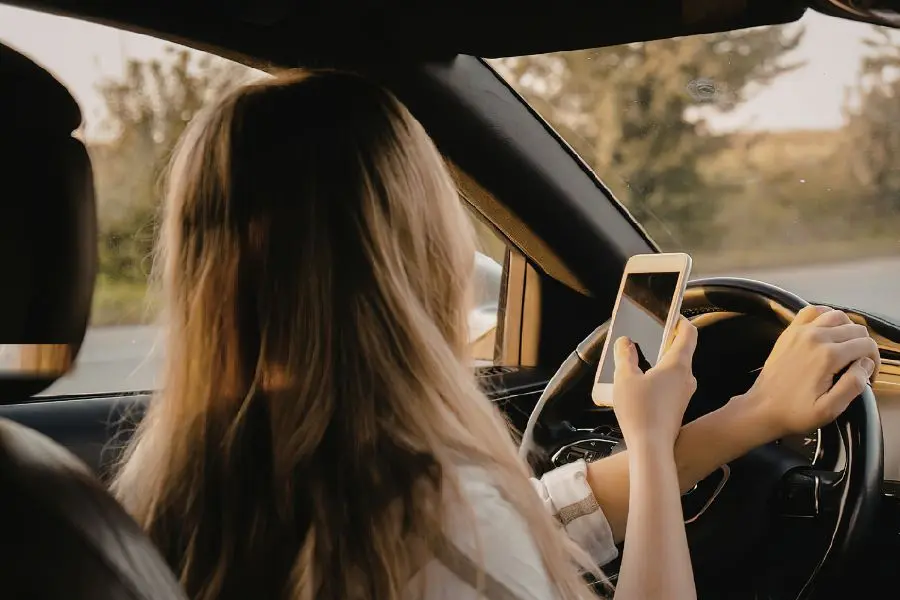
Texting hits all three at once. That is why it produces the most dangerous outcomes. It does not just reduce one aspect of a driver’s capacity to respond — it eliminates three simultaneously, for however long the exchange lasts.
What California Distracted Driving Law Covers — and Where It Draws the Line
California has some of the stronger distracted driving laws in the country. Under the California Vehicle Code:
- All drivers are prohibited from holding or operating a handheld wireless device while driving
- Texting while driving is prohibited for all drivers under Vehicle Code 23123.5
- Drivers 18 and under are prohibited from using any wireless device while driving, including hands-free
- A first citation for a handheld cell phone violation carries a minimum fine of $162, with higher penalties for repeat offenses
- Repeat violations result in a point on a driver’s license record
Hands-free use is permitted for adult drivers, with the device mounted to the dash or windshield. The phone cannot be held.
California’s framework is meaningfully stricter than many states. That matters — both for deterrence and for what it signals about the standard of care California expects from drivers on its roads. When a driver violates these statutes and causes a crash, that violation is directly relevant to any civil claim that follows.
Why a Distracted Driver Can Be Held Liable Even Without a Criminal Charge
A citation or criminal charge is not required for civil liability to attach. California personal injury law operates on a negligence standard, and distracted driving establishes negligence whether or not law enforcement issued a ticket at the scene.
Every driver on a California road owes a duty of reasonable care to others. Picking up a phone, looking away to adjust a GPS, eating while merging on the 101 — any of these can breach that duty. When a breach causes an injury, the injured party has the right to pursue compensation for the resulting damages.
Unlike North Carolina, California follows a pure comparative fault standard. This means that even if an injured person is found to bear some portion of fault for a crash, they can still recover compensation. Their recovery is reduced by their percentage of fault, but it is not eliminated by it. This is a meaningful distinction. It means that insurance companies cannot use a minor technical fault on the victim’s part to wipe out a claim entirely — which is a common tactic in states with harsher contributory negligence rules.
What to Do Immediately After a Distracted Driving Crash in California
The actions taken in the minutes, hours, and days following a crash directly shape the strength of any legal claim.
Call 911. Even when a crash seems minor and the other driver appears cooperative, a police report is essential. It documents the scene, captures initial statements, and creates a record that cannot be altered after the fact. Officers trained to spot distraction may note observations that prove valuable later.
Document everything at the scene. Photograph both vehicles, the surrounding area, road conditions, traffic controls, and any visible injuries. Collect names and contact information from witnesses before they leave. Write down anything the other driver says, particularly anything suggesting they were using a phone or were otherwise not paying attention.
Get medical attention the same day. Not all injuries announce themselves immediately. Concussions, soft tissue damage, and internal injuries may not be apparent in the adrenaline of a crash. Delayed treatment creates a gap that insurers will use to argue that injuries were either not serious or not caused by the crash. Both arguments are avoidable with prompt care.
Do not provide a recorded statement to the other driver’s insurance company. This is one of the most common and most damaging mistakes crash victims make. Adjusters are trained to ask questions that produce admissions. You are not legally required to give a recorded statement, and doing so before speaking with an attorney is rarely in your interest.
Why Distracted Driving Evidence Disappears Faster Than Most Victims Expect
Cell phone data is one of the most powerful forms of evidence in a distracted driving case. Records showing that a driver was actively using their device at the moment of impact can be subpoenaed — but carriers do not retain that data indefinitely. A preservation letter to the carrier, sent early, can prevent deletion before litigation begins.
Vehicle event data recorders capture speed, braking behavior, and steering inputs in the seconds before a crash. That data can be permanently lost if a vehicle is repaired or sold before it is formally preserved. The same is true for dashcam footage, traffic camera recordings, and surveillance video from nearby businesses — all of which typically overwrite on short cycles.
The longer a victim waits to involve an attorney, the narrower the window for preserving this evidence becomes. This is not a reason to panic, but it is a reason to move. Witnesses become harder to reach. Physical impressions at the scene disappear. Medical records become harder to connect to the crash. None of this is insurmountable, but all of it is more difficult with time.
How California’s Comparative Fault System Affects a Distracted Driving Claim
California’s pure comparative fault rule means that fault in a crash is apportioned between parties. If the at-fault driver was 90 percent responsible and the injured person was 10 percent responsible, the injured person recovers 90 percent of their damages.
This is more favorable to injury victims than the rules in many other states. It also means that insurance companies have less incentive to fabricate a full-fault defense and more incentive to argue about percentages. Expect the other side to look for any behavior by the injured party that can be characterized as careless — following distance, speed, lane position, phone use, seatbelt status.
An experienced personal injury attorney anticipates these arguments. The goal is not to present a perfect client. The goal is to accurately establish what each party actually did, document the at-fault driver’s distraction thoroughly, and ensure the percentage of fault assigned to each party reflects the evidence rather than the insurer’s preferred narrative.
When to Contact a California Distracted Driving Accident Attorney
The right time to call is before you think you need to.
Most people contact an attorney after something has gone wrong — a lowball offer, an insurer that has gone quiet, a medical bill that dwarfs the settlement being discussed. By that point, evidence may be gone and options may be narrower than they were weeks earlier.
California’s statute of limitations for personal injury claims is generally two years from the date of the injury. That is shorter than many people assume, and it is shorter than the statute in several other states. Two years sounds like enough time. It is not always. Cases require investigation, documentation, expert review, and negotiation — all of which take time to do well.
You do not need to have a settled view of your damages or a complete medical picture before reaching out. A consultation with a personal injury attorney is simply a conversation about what happened, what the evidence shows, and what your options are. There is no cost to that conversation, and the information you get from it has real value regardless of what you decide to do next.
Why Distracted Driving Awareness Month Matters Beyond the Campaign
NHTSA’s Distracted Driving Awareness Month pairs national public education with law enforcement efforts under the “Put the Phone Away or Pay” campaign. The California Highway Patrol runs parallel enforcement operations throughout April, targeting handheld device violations across the state.
The campaigns serve a purpose. Behavior shifts when enforcement is visible and consequences are real. But a public awareness campaign does not undo a crash that has already happened. It does not pay a hospital bill, replace lost income, or compensate for permanent injury.
For people who have already been hurt, what matters now is not a slogan. It is understanding their rights, preserving their evidence, and making sure the driver responsible is held accountable.
The 148 deaths and thousands of injuries recorded in California’s most recent distracted driving data represent real people — people who were on their way somewhere when someone else decided a phone was more important than the road.
That is the price of looking away. And it is one that the at-fault driver, not the victim, should be made to pay.
If you or someone you love was injured in a crash caused by a distracted driver, Big Joe Law is ready to help. Our Encino personal injury team has the experience to build your case, fight the insurance company, and pursue the compensation you deserve. Contact us today for a free consultation.
Sources
National Highway Traffic Safety Administration. Distracted Driving. https://www.nhtsa.gov/risky-driving/distracted-driving
National Highway Traffic Safety Administration. Research Note: Distracted Driving in 2023. https://crashstats.nhtsa.dot.gov/Api/Public/Publication/813703
California Office of Traffic Safety. Distracted Driving. https://www.ots.ca.gov/grants/distracted-driving/
California Highway Patrol. Distracted Driving. https://www.chp.ca.gov/siteassets/images/distracted_driving.pdf
California Highway Patrol. CHP Focused on Tackling Distracted Driving Epidemic. https://www.chp.ca.gov/PressReleases/Pages/CHP-FOCUSED-ON-TACKLING-DISTRACTED-DRIVING-EPIDEMIC.aspx
California Department of Transportation. Strategic Highway Safety Plan Statewide Factsheet. https://dot.ca.gov/-/media/dot-media/programs/safety-programs/documents/shsp/shsp-ca-statewide-factsheet-a11y.pdf
California Vehicle Code § 23123. https://leginfo.legislature.ca.gov/faces/codes_displaySection.xhtml?lawCode=VEH§ionNum=23123.
California Vehicle Code § 23123.5. https://leginfo.legislature.ca.gov/faces/codes_displaySection.xhtml?lawCode=VEH§ionNum=23123.5.